1. American Art Therapy Association (AATA)
- Art therapy has been shown to improve mood, reduce anxiety and depression, and increase resilience.
- Especially effective with people who have experienced trauma, dementia, or chronic illness.
- Website: www.arttherapy.org
- Art for the Journey offers Therapeutic Art experiences which aligns with principles of art therapy but is not the same. See the blog post describing the difference here.
2. World Health Organization (WHO) — 2019 Report
- “What is the evidence on the role of the arts in improving health and well-being?”
- Reviewed over 900 publications.
- Conclusion: Arts play a major role in the prevention of illness, promotion of health, and management and treatment of disease across the lifespan.
- Examples: Dance for Parkinson’s, music therapy in dementia, painting and drawing to reduce trauma in children.
3. National Endowment for the Arts (NEA) Research
- NEA has funded numerous studies on creative aging, art and trauma, and arts in healthcare.
- Findings include:
- Older adults who participate in arts programs show improved memory, mobility, and social engagement.
- Veterans in arts programs experience reduced PTSD symptoms and enhanced well-being.
- Website: arts.gov
4. Drexel University Study (2016)
- Study on 45 minutes of art-making showed significant reductions in cortisol levels (a stress hormone).
- Effects seen regardless of artistic experience.
- Led by Dr. Girija Kaimal, a leader in arts and health research.
🧪 Source:
Kaimal, G., Ray, K., & Muniz, J. (2016). Reduction of Cortisol Levels and Participants’ Responses Following Art Making. Art Therapy, 33(2), 74–80.
5. NIH-funded research
- NIH (National Institutes of Health) is investing in research that looks at music, dance, and visual art as interventions for:
- Chronic pain
- Depression and anxiety
- Parkinson’s disease
- Alzheimer’s and other dementias
Documented Benefits of Art-Making:
| Benefit | Description |
| Reduced Stress | Lowers cortisol and anxiety levels. |
| Improved Mood | Enhances positive emotions and reduces symptoms of depression. |
| Cognitive Function | Stimulates brain activity, especially in older adults and people with dementia. |
| Social Connection | Builds empathy, reduces isolation, and increases engagement. |
| Physical Health | Improves motor skills, pain tolerance, and physical rehabilitation outcomes. |
| Emotional Expression | Helps people process grief, trauma, and complex feelings without needing verbal articulation. |
Notable Programs Reflecting the Research
- Opening Minds through Art (OMA) – Used for people with dementia to foster connection and autonomy.
- Creative Forces: NEA Military Healing Arts Network – Demonstrates success in treating PTSD and TBI.
- Arts on Prescription (UK) – Doctors refer patients to art classes; shown to reduce visits to healthcare providers.
📘 Full report summary: WHO Arts & Health Report (2019)
Art for the Journey is honored to have delivered the Opening Minds through Art (OMA) program since 2016 and accumulating data that aligns with the Founder of OMA, Dr. Elizabeth Lokon’s research that proves an increase in well-being for participants. Research developed by Dr. Lokon at Scripps Gerontology Center, Miami University, OH can be found here. Note in particular the journal highlighting quotes of participants such as: “It makes me feel like myself”: Person-centered versus traditional visual arts activities for people with dementia. 2016 Sauer, P. E., Fopma-Loy, J., Kinney, J. M., & Lokon, E.
Since 2018, Art for the Journey has been partnering directly with Miami University, Ohio as “Master Trainers” certifying others to facilitate the OMA Program. We are one of four training centers globally. To date, we have certified more than 300 individuals at more than 150 locations across the USA and Canada. We continue to provide the robust training and OMA Facilitator Certification Course and are supported by Dr. Dianne Simons, VCU Faculty Emeritus and have engaged Capstone doctoral researchers from VCU Occupational Therapy Department of VCU College of Health Professions all who have used the training as a starting point for their own research in creating solutions for programs for people of all ages with varying need.
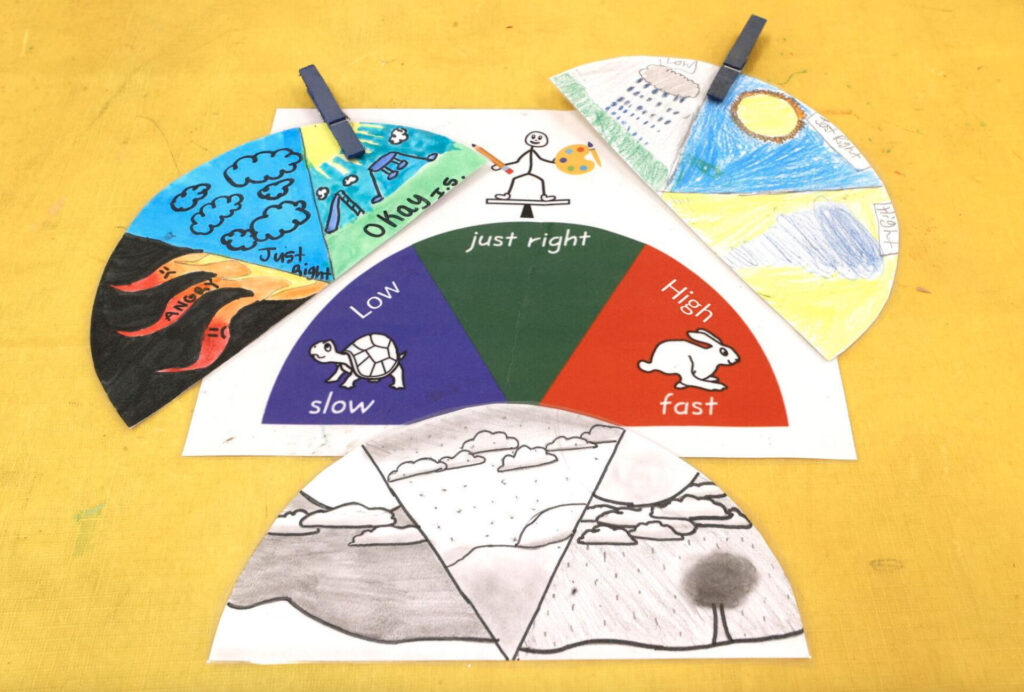
OT Researcher and Capstone researcher, Dr. Olivia Fields created a tool for our work with youth who have experienced Trauma. The tool explores emotional regulation and helps children understand their personal perception to the state of their emotions and how to adjust to the state where learning and participation is optimized, and why that is important. The tool is created in art class, and explained through children creating a personalized tool to use to help both the child and the teacher. The project starts with a discussion of what image do I create in my mind for feeling “Just right” to learn or to be present. This is the center section. Next, what if I had not had a good night’s sleep, or feel tired and slow? What image can I place in that section. And finally, what if I feel like my thoughts are and my body is racing!, and it’s hard to focus? Each day, students place a close pin where they feel they are, and next, the teacher is able to suggest ways to adjust. Ways such as wall push up, squeeze balls, a walk about, or a quiet time, all available for adjustment.
This project directly works to promote positive mental health and well-being through self awareness, self modulation, and communication through art.
In 2020, Dr. Hannah Johnson created a volunteer training to support our work with veterans living with P.T.S.D. and other combat related disabilty. Her work followed the work of Dr. Erin Oakley, who developed a veterans program initiative and assessment tool to indicate the impact of Art for the Journey art programs for veterans living with PTSD.
Art for the Journey is grateful to researchers who join us to help us understand impact and provide best practice approaches in all of our programs.
Recently, Several undergrad students, MBA researchers and High School students have supported all of our endeavors. We will focus on what is next to prepare our expansion of the OMA program to impact additional need based groups under the adaptation program, “Elevating Lives through Art” (ELA). ELA is also research and data-driven using the pillars of the extraordinary OMA program. 2025 is our testing year for adaptations and we look forward to sharing the results as well as further developing training and certification. We continue to partner to Scripps Gerontology Center as OMA Certification trainers, and are grateful to partner with extraordinary faculty and students from VCU and University of Richmond.
“Art has the power to unite, uplift, and heal communities from the inside out.”